
Search engine
 optimization (SEO)
Content marketing
Social media marketing
Pay per click (PPC)
Native advertising
Affiliate marketing
Influencer marketing
Email marketing
Marketing automation
Online PR
Mobile marketing
Conversion rate optimization (CRO)
01.Search engine optimization (SEO)
Digital Marketing (SEO)
A foundational element of digital marketing, SEO is the practice of optimizing your website to rank higher in search engine results. When your website appears as a top result on Google and other search engines, people are more likely to click on your link, learn about your brand, and perhaps even become customers.
There are three broad ways to improve your website’s SEO:
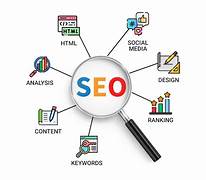
On-page SEO involves optimizing the pages on your website by conducting keyword research. When you incorporate strategic keywords throughout your site, you can rank high on search engine results pages and guide customers through the sales funnel with relevant, authoritative content.
Off-page SEO is about improving your SEO by looking at pages external to your website. Inbound links to your website—known as backlinks—are a critical component of off page SEO. Networking with publishers, writing guest posts, and providing information-rich content on your blog can help improve your off-page SEO.
Technical SEO deals with the backend elements of your website such as coding, structured data, image compression and more. Optimizing these elements can make it easier for search engines to “read” your site and improve your page speed.
These fit naturally in blogs, ads, and SEO content:
- Addition: furthermore, moreover, in addition, also
- Contrast: however, on the other hand, although
- Cause/Effect: therefore, as a result, because
- Emphasis: in fact, importantly, notably
- Sequence: first, next, finally
02. Content marketing
Closely tied to SEO, content marketing is also a core component of digital marketing. T
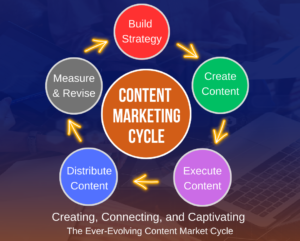
his involves creating and promoting content with the goals of building brand awareness, increasing traffic to your website, generating leads and converting customers.\
The content you create can take many forms:
Blog posts: Creating a blog – and using strategic, long tail keywords in your articles – is a great way to bring traffic to your site and engage your customers.
Ebooks and white papers: Adding in-depth, long-form content to your website establishes your expertise in the industry and builds trust among your audience. You can also offer this content for download in exchange for your readers’ contact information, helping you generate leads.
Videos: Website content doesn’t need to be in written form. Adding videos to your website is an engaging way to provide valuable information to your audience.
Infographics: Another form of visual content, infographics are a fun, helpful way to make information easier for readers to conceptualize. Complex explanations and statistics are particularly well-suited to this content format. Learn more about how to make an infographic with Wixel.
Podcasts: This audible content format is a useful way to strengthen your connection with your audience and build a loyal community around your brand. Content can be interview-based or niche-focused like Wix’s SERP’s Up SEO Podcast. To start a podcast, try repurposing existing website content, such as blog posts, and adapting it for audio.
Webinars: A merging of “web” and “seminar,” webinars further engage your audience, establish your authority, and delight customers with the extra value they provide.
Whichever content formats you choose, be sure to focus on subject matter that’s relevant and valuable for your audience and that will help boost your website’s SEO.
03. Social media marketing
Digital Marketing (SMM)
Another cornerstone of a strong digital marketing strategy is social media marketing. This involves promoting your brand on social channels in order to increase brand awareness, drive traffic to your website, and capture leads. You can do this by creating posts on popular social media channels such as:
Facebook
Instagram
Twitter
Pinterest
LinkedIn
Your posts can include anything from insightful blog articles to videos of your product in action. Choose channels on which your audience is most active; often, this is a factor of their demographics, such as age and location, as well as their interests. You can even invest in sustainable marketing in these channels, which has become popular as consumer demand for environmentally-friendly products has grown.
04. Pay per click (PPC)
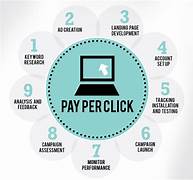
Digital Marketing (PPC)
Some digital marketing methods, such as blogging, SEO, and social media posting are organic—meaning that they draw traffic “naturally” to your business rather than requiring that you spend money directly. Other practices, however, come with a price tag.
PPC, an acronym for pay per click, is a particularly powerful form of paid online advertising. Like SEO, PPC is a type of search engine marketing, or SEM. If you’re familiar with posts labeled “Ad” at the top and bottom of Google search results pages, you’ve already seen PPC in action.
By this model, advertisers pay a fee every time their link is clicked. As with other forms of digital marketing, the goal of PPC is to drive traffic to a website in order to generate leads and make sales.
Generally, PPC is used on either search engines or social media platforms:
Google: Search engine marketing PPC is most commonly associated with Google Ads. Take a look at this article to learn how to advertise on Google.
Facebook: You can further use the pay per click model to advertise on Facebook. Creating paid Facebook posts helps you expand your reach, exposing your content to people who don’t follow you.
LinkedIn: You can also do PPC on LinkedIn, helping you get in front of professional audiences.
Twitter: Likewise, you can use Twitter Ads to target your relevant audience and expand your reach.
05. Native advertising
Native advertising, too, is a popular online marketing model.  In contrast to large pop-ups and other intrusive ads, native ads match the format and tone of the platform on which they appear. Native ads often appear on websites, and they display content that “blends in” with surrounding articles or blog posts. For example, they might appear as a video embedded within a blog post, or as recommended reading at the bottom of the page.The goal of native advertising is to guide users to click on content that will take them to your company’s page. If the advertised content is unobtrusive and highly relevant to the material at hand, users may be more enticed to click.
Discover the latest trends in video marketing with these video marketings statistics.
06. Affiliate marketing
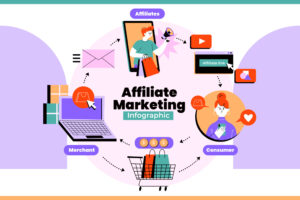
Digital Marketing (AM)
Affiliate marketing is a digital marketing practice in which one party, such as an influencer or a brand, receives a commission for promoting someone else’s products or services. For businesses, this practice is beneficial because it allows them to reach that party’s followers.
By the affiliate marketing model, a company provides that party (called the affiliate) with a special link, usually leading to a page to purchase their product. The affiliate, in turn, will post about that product (usually on their blog or social media pages), promoting the given link in their content. When users click on that link and buy, it’s a win-win for both the brand and the affiliate: the company makes a sale, and the affiliate earns a commission on that sale.Brands can connect with affiliates using platforms such as ShareASale or CJ Affiliate, or by reaching out to influencers directly.
07. Influencer marketing
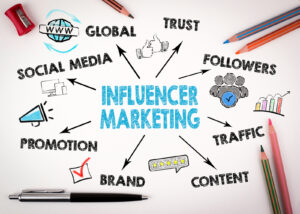
Digital Marketing (IM)
This practice is similar to affiliate marketing in that it involves another person promoting your brand, typically on social media or within their blog. Unlike affiliates, however, influencers get paid by the company simply for the promotion – regardless of whether people actually purchase the product.
Influencer marketing is effective because it helps brands reach a particular influencer’s fanbase. When that influencer is trusted among their followers, they have the power to sway their fans’ purchasing decisions by recommending a product.
On the business side, the key to a successful partnership is to choose influencers whose audience matches your target market. For example, a company selling athletic wear would benefit most from collaborating with a well-known athlete. Likewise, a business selling cosmetics would be wise to seek out a collaboration with a beauty influencer.
08. Email marketing
Digital Marketing (EM)
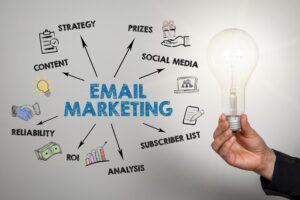
You’ve almost certainly experienced email marketing in some form – in fact, you probably have branded emails sitting in your inbox right now. This popular digital marketing strategy involves communicating with your target audience via email with the goals of improving engagement, promoting products and driving conversions and sales.
Broadly speaking, there are four different types of marketing emails you can send to prospects and customers:
Email campaigns promote products, provide special offers or coupons, or encourage people to sign up for a product or service.
Email newsletters are sent on a consistent basis to provide subscribers with regular updates, such as new blog posts, industry news or upcoming events.
Automated marketing emails are sent automatically based on predefined triggers, and they include welcome emails, birthday emails and reminder emails.
Automated transactional emails include automatic order confirmations, shipping updates and appointment reminders.
You can use Wix Email Marketing to set up email campaigns, newsletters and automations for your business. This platform is particularly effective because it tracks statistics on email opens, views and clicks, giving you insight into your business’s performance. It also allows you to customize the design of your emails so that they match the look and feel of your brand.
09. Marketing automation

Speaking of automated emails - they’re examples of a broader digital marketing practice called marketing automation. As the name suggests, this involves the automation of basic marketing tasks. The idea behind this practice is to streamline repetitive tasks that would otherwise be done manually, such as transactional emails, data analysis and more. Some tasks that benefit from automation include: Thank you, confirmation and welcome emails Social media post scheduling Live chat Data analytics Marketing automation is a critical way to build relationships with your customers while sustaining an organized and productive workflow.
10. Online public relations (PR)
Digital Marketing Online (PR)
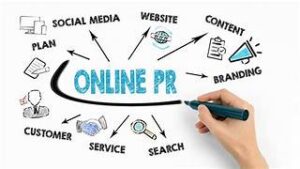
Online PR is the practice of obtaining coverage from online publications and blogs. This tends to require outreach to reporters and editors at relevant publications, which you can do through LinkedIn or Twitter.
PR also involves monitoring your brand’s reputation on the web overall. For example, you’ll need to engage with comments on your blog and social media posts, as well as respond to online reviews of your company.
11. Mobile marketing
Digital Marketing (MB)
Often, converting customers through the screens of their laptops seems like the ultimate goal. It’s important, however, that we also take full advantage of a smaller – but equally important – device: the smartphone. This is especially important considering that mobile internet usage comprises more than 50% of online traffic worldwide.
Mobile marketing involves adapting standard digital marketing practices to fit the mobile experience. This includes:
Optimizing your mobile page speed: Google uses page speed as a ranking factor for mobile as well as desktop search. In addition, users are quick to navigate away from a site with a slow load time. To improve the speed of your mobile site, try to keep your site lightweight—for instance, avoid heavy images, and minimize redirects.
Designing your website for mobile: Your site is a fundamental marketing tool that represents your brand, showcases your product or service, and persuades people to buy. As such, the way it appears on mobile plays a crucial role in whether or not your audience will convert. Take a look at this article for mobile website design examples and tips.
Creating mobile-friendly emails: Research shows that mobile accounts for nearly half of all email opens. With this in mind, it’s critical that your email campaigns are designed for the mobile screen. That means short subject lines, concise text and a clear and prominent CTA.
Experimenting with in-app ads: Don’t limit your ads to websites and search engines. Advertising within relevant mobile apps (as well as ASO marketing) is also a valuable practice that can expand your reach even further.
12. Conversion rate optimization (CRO)
Digital Marketing (CRO)
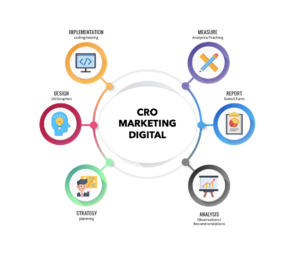
If we need to sum up the goals of digital marketing, we’d say it’s about bringing traffic to your site and increasing conversions. This latter component—called conversion rate optimization—requires designing your website with an understanding of the way users interact with it.
To do this, you’ll need to take into account how users navigate your site, which actions they take, and what guides them toward—or prevents them from—achieving your goals. Tracking tools and analytics can provide you with quantitative data about the ways users engage with your site, helping you guide them smoothly through the sales funnel.